


『How to Calibrate Magnetic Flow Meter: Use factory wet-proving water loops to verify electrode voltage linearity across multiple test runs.』Related information(v cone flow meter|rotary gas meter|gallon meter|gear meter|metal tube rotameter|glass tube rotameter|nutating disk meter|transit time ultrasonic flow meter|wedge flow meter|pd meters|hydraulic flow meter|ultrasonic water flow meter|water flow meter|air flow meter|magnetic water flow meter|oxygen flow meter|gas flow meter|argon flow meter|air velocity meter|gasoline flow meter|fuel flow meter|ultrasonic water meter|digital water meter|nitrogen flow meter|solid flow meter|Oxygen tank flow meter|digital water flow meter|diesel fuel flow meter|steam flow meter|02 flow meter|compressed air flow meter|oil flow meter|liquid flow meter)

How to Calibrate Magnetic Flow Meter: Use Factory Wet-Proving Water Loops to Verify Electrode Voltage Linearity Across Multiple Test Runs
Quick Answer: Calibrate a magnetic flow meter on a factory wet-proving water loop. Compare meter output against a traceable reference at multiple flow points. This verifies electrode voltage linearity across the full flow range. Silver Automation Instruments ships magmeters with this calibration certificate and raw test data.
Why Factory Calibration Beats Field Guesswork
Field calibration can check zero only. Most engineers skip full calibration in the field for a reason. A magnetic flow meter reads microvolt level voltage from electrodes in a conductive liquid. Small liner shifts or ground loop noise can change that voltage. In practice, a factory wet-proving water loop gives clean water and stable pressure. The line size is known. You cannot get that stability on a bypass line in a chemical plant in Vietnam or a desalination plant in Oman.
Silver Automation Instruments calibrates magmeters from DN15 up to DN600 on wet loops. The water conductivity stays above 20 µS/cm. A PT100 sensor monitors loop temperature. The reference meter is checked against a calibrated master meter. This is not a dry simulation.
What Wet-Proving Water Loops Actually Check
A wet-proving water loop checks the meter under real flow velocity. Common test points are 0.3 m/s, 1 m/s, 2 m/s, 5 m/s, and 10 m/s. For a DN100 PTFE lined sensor, that means roughly 8.5 m³/h to 283 m³/h. The sequence runs from low flow to high flow. Then it runs back down. This catches hysteresis and zero shift.
During each run, the transmitter reads electrode voltage. The electrode voltage should track flow velocity in a straight line. If voltage linearity is off, the transmitter may be compensating incorrectly. Factory wet-proving catches that before the meter leaves the test bench.
Electrode Voltage Linearity and Multiple Test Runs
Here is the thing about electrode voltage. It is a microvolt level signal. Noise or ground leakage can ruin repeatability. On the wet loop, Silver Automation Instruments runs at least three passes at each flow point. High accuracy orders get five passes. The calibration software records each pass and compares the curve.
We use factory wet-proving water loops to verify electrode voltage linearity across multiple test runs. This process checks the output above 0.3 m/s. For a standard electromagnetic flowmeter, accuracy is often ±0.5 percent of reading. For a high accuracy model with 4-20 mA HART output, it may be ±0.2 percent. The final certificate includes the measured error at each test point.
Calibration Data You Should Receive
Do not accept a meter with only a generic certificate. Ask for actual test data. Silver Instruments provides the flow rate, the reference meter value, the device under test value, and the error at each point. You also get average error and repeatability across multiple runs.
A clean data set looks like this. At 5 m/s on a DN80 meter, the reference loop reads 90.5 m³/h. The magmeter output reads 90.2 m³/h. The error is minus 0.33 percent. The next run reads 90.3 m³/h. That is repeatable. Keep this file for your plant audit.
How Silver Automation Instruments Handles Magmeter Calibration
We build the calibration loop around actual process conditions. The loop can handle water at ambient temperature and heated water up to 80 °C for some liner checks. We check coil current and electrode resistance. We also check empty
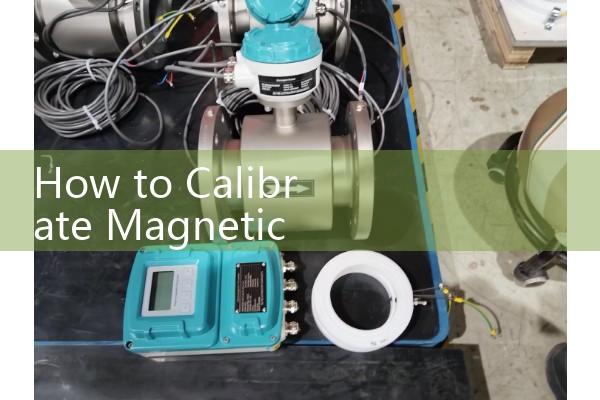
Most engineers also ask about liner type. PTFE liners suit chemical dosing and food grade lines. Hard rubber liners suit water and wastewater. The calibration loop uses clean water with viscosity near 1 cP at ambient temperature. Liner type matters less for linearity. But we still verify the final meter with the exact liner and electrode material ordered. Last year a customer in Vietnam asked us to recalibrate a DN150 magmeter for a seawater intake. The factory loop found a 0.4 percent zero shift. We corrected it and sent the meter back with new data.
Field Verification After Installation
Once the meter arrives, you can do a field zero check. Fill the pipe with process liquid and make sure flow is zero. The transmitter should read zero within the published limit. If you see drift, check the grounding rings and the cable shield. Do not try to recreate the full wet-proving in the field. That is what the factory loop is for.
We have seen this on customer sites many times. A magmeter installed near a VFD pump shows unstable reading. The plant team blames the meter. The real cause is a missing grounding strap. The factory calibration data stays valid. The field wiring needs correction.
What to Send for a Magnetic Flow Meter Calibration Quote
For a magmeter calibration quote or a new meter order, send us these details. Pipe size in DN, flow range in m³/h, L/h, or kg/h, fluid conductivity in µS/cm, process temperature in °C, pressure in bar, liner material, electrode material, and output type. For example, a food grade milk magmeter may be DN50, 0.2 to 20 m³/h, conductivity above 200 µS/cm, CIP heated to 120 °C, PN16 flange, 4-20 mA HART output, and 316L electrodes.
For a fast quote, send us your pressure (bar), temperature (°C), pipe size (DN), and flow range. Contact Silver Automation Instruments. Tel: +86-135-1213-1526. Whatsapp: 86-135-12131526. WeChat: +86 13512131526. You can also visit flow-meter.com.au. We ship to Southeast Asia, Oceania, Latin America, Africa, and the Middle East.
FAQ: Magnetic Flow Meter Calibration
How often should a magnetic flow meter be calibrated?
Factory calibration is standard before shipment. In critical applications, recheck every 12 to 24 months. For water and wastewater, many plants rely on a field zero check and keep the factory certificate for 3 to 5 years.
Can you calibrate a magnetic flow meter in the field?
You can do a zero check and a coarse comparison with a portable clamp on flowmeter. Full wet-proving is not practical in the field. The factory water loop gives controlled pressure, clean water, and a traceable reference meter.
What flow points are used in wet-proving?
Common points are 0.3, 1, 2, 5, and 10 m/s. Each point is run three to five times. The loop then verifies linearity and repeatability across the full range.
What accuracy can a calibrated magmeter achieve?
A standard Silver Instruments magmeter achieves ±0.5 percent of reading above 0.3 m/s. A high accuracy model with 4-20 mA HART can achieve ±0.2 percent. The certificate shows the measured error at each test point.
What information do you need for a magmeter calibration quote?
Send us pipe size in DN, flow range in m³/h, L/h, or kg/h, fluid conductivity in µS/cm, temperature in °C, pressure in bar, liner material, electrode material, and output type. We will recommend the right model and calibration plan.
 Hot Product
 Related AD
