『2000 mPa.s flow meter』Related information(v cone flow meter|rotary gas meter|gallon meter|gear meter|metal tube rotameter|glass tube rotameter|nutating disk meter|transit time ultrasonic flow meter|wedge flow meter|pd meters|hydraulic flow meter|ultrasonic water flow meter|water flow meter|air flow meter|magnetic water flow meter|oxygen flow meter|gas flow meter|argon flow meter|air velocity meter|gasoline flow meter|fuel flow meter|ultrasonic water meter|digital water meter|nitrogen flow meter|solid flow meter|Oxygen tank flow meter|digital water flow meter|diesel fuel flow meter|steam flow meter|02 flow meter|compressed air flow meter|oil flow meter|liquid flow meter)
Of course. Here is a detailed article about flow meters designed for fluids with a viscosity of 2000 mPa·s.
---
### Navigating High Viscosity: The Challenges and Solutions for 2000 mPa·s Flow Measurement
Accurate flow measurement is a cornerstone of process control in countless industries, from chemical manufacturing and food processing to oil and gas. However, the task becomes exponentially more complex when the fluid in question is not a free-flowing liquid like water but a thick, heavy substance. When an application demands a flow meter for a fluid with a viscosity of **2000 mPa·s**, engineers face a unique set of challenges that require specialized instrumentation and a deep understanding of fluid dynamics.
A viscosity of 2000 millipascal-seconds (mPa·s) places a fluid squarely in the "high-viscosity" category. To put this in perspective, water has a viscosity of approximately 1 mPa·s at room temperature. Common household liquids like corn syrup or honey are around 1000–5000 mPa·s, while heavy crude oil, certain polymer melts, and concentrated slurries often fall into this range. At this thickness, the fluid resists flow significantly, and its behavior is dominated by shear forces. A conventional flow meter designed for low-viscosity liquids will likely fail, producing wildly inaccurate readings or becoming mechanically damaged.
**The Core Challenges with High-Viscosity Flow**
1. **Non-Newtonian Behavior:** Many fluids at 2000 mPa·s are non-Newtonian. This means their viscosity changes with the rate of shear (flow velocity). A ketchup-like fluid might be thick when static (high viscosity) but become thinner when pumped (lower viscosity). This dynamic change can confuse many meter types.
2. **Pressure Drop and
Energy Loss:** Moving a highly viscous fluid requires significant energy. Any obstruction in the flow path, such as a turbine blade or a small orifice, creates a massive pressure drop that can starve the pump or damage the process.
3. **Slip and Slippage:** In some meter designs, the thick fluid may not move uniformly. It can "slip" past measuring elements or create a boundary layer that is not detected, leading to under-reporting of flow.
4. **Clogging and Fouling:** Sticky or particulate-laden fluids can coat internal sensors, clog small passages, and lead to rapid mechanical wear.
5. **Start-up Transients:** Pumping a cold, thick fluid requires a high "break-away" torque. The flow meter must be robust enough to handle slug flow and pulsations during start-up without damage.
**Evaluating Flow Meter Technologies for 2000 mPa·s**
Given these challenges, only certain flow meter technologies are suitable. The best choice depends on the fluid’s conductivity, abrasiveness, temperature, and the required accuracy.
1. **Positive Displacement (PD) Meters:** These are often the workhorses for high-viscosity fluids. PD meters, such as oval gear, helical gear, or lobed impeller designs, work by physically trapping a fixed volume of fluid and counting the number of times this volume is filled and emptied. They excel at high viscosity because the thick fluid seals the moving parts, reducing internal slippage and improving accuracy.
- *Best for:* Custody transfer, batching, and applications requiring high turndown ratios.
- *Key Concern:* Mechanical wear from abrasive particles and high pressure drop.
2. **Coriolis Mass Flow Meters:** This is the gold standard for accuracy and versatility. A Coriolis meter measures m



 Of course. Here is a detailed article about flow meters designed for fluids with a viscosity of 2000 mPa·s.
---
### Navigating High Viscosity: The Challenges and Solutions for 2000 mPa·s Flow Measurement
Accurate flow measurement is a cornerstone of process control in countless industries, from chemical manufacturing and food processing to oil and gas. However, the task becomes exponentially more complex when the fluid in question is not a free-flowing liquid like water but a thick, heavy substance. When an application demands a flow meter for a fluid with a viscosity of **2000 mPa·s**, engineers face a unique set of challenges that require specialized instrumentation and a deep understanding of fluid dynamics.
A viscosity of 2000 millipascal-seconds (mPa·s) places a fluid squarely in the "high-viscosity" category. To put this in perspective, water has a viscosity of approximately 1 mPa·s at room temperature. Common household liquids like corn syrup or honey are around 1000–5000 mPa·s, while heavy crude oil, certain polymer melts, and concentrated slurries often fall into this range. At this thickness, the fluid resists flow significantly, and its behavior is dominated by shear forces. A conventional flow meter designed for low-viscosity liquids will likely fail, producing wildly inaccurate readings or becoming mechanically damaged.
**The Core Challenges with High-Viscosity Flow**
1. **Non-Newtonian Behavior:** Many fluids at 2000 mPa·s are non-Newtonian. This means their viscosity changes with the rate of shear (flow velocity). A ketchup-like fluid might be thick when static (high viscosity) but become thinner when pumped (lower viscosity). This dynamic change can confuse many meter types.
2. **Pressure Drop and
Of course. Here is a detailed article about flow meters designed for fluids with a viscosity of 2000 mPa·s.
---
### Navigating High Viscosity: The Challenges and Solutions for 2000 mPa·s Flow Measurement
Accurate flow measurement is a cornerstone of process control in countless industries, from chemical manufacturing and food processing to oil and gas. However, the task becomes exponentially more complex when the fluid in question is not a free-flowing liquid like water but a thick, heavy substance. When an application demands a flow meter for a fluid with a viscosity of **2000 mPa·s**, engineers face a unique set of challenges that require specialized instrumentation and a deep understanding of fluid dynamics.
A viscosity of 2000 millipascal-seconds (mPa·s) places a fluid squarely in the "high-viscosity" category. To put this in perspective, water has a viscosity of approximately 1 mPa·s at room temperature. Common household liquids like corn syrup or honey are around 1000–5000 mPa·s, while heavy crude oil, certain polymer melts, and concentrated slurries often fall into this range. At this thickness, the fluid resists flow significantly, and its behavior is dominated by shear forces. A conventional flow meter designed for low-viscosity liquids will likely fail, producing wildly inaccurate readings or becoming mechanically damaged.
**The Core Challenges with High-Viscosity Flow**
1. **Non-Newtonian Behavior:** Many fluids at 2000 mPa·s are non-Newtonian. This means their viscosity changes with the rate of shear (flow velocity). A ketchup-like fluid might be thick when static (high viscosity) but become thinner when pumped (lower viscosity). This dynamic change can confuse many meter types.
2. **Pressure Drop and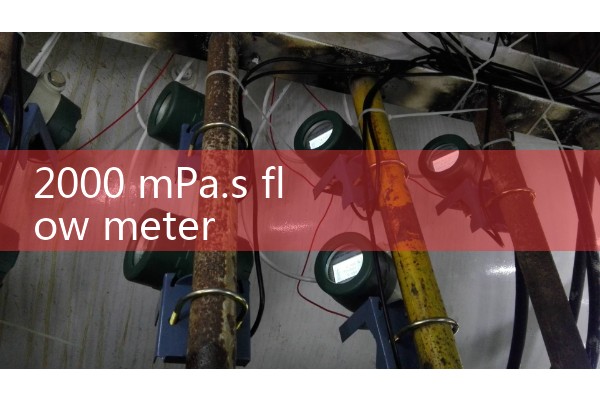
 Hot News
 Related AD
