

 Current position > Product detail
『Diesel Fuel Flow Meter Marine: Boat Fuel Efficiency Logbooks』Related information(v cone flow meter|rotary gas meter|gallon meter|gear meter|metal tube rotameter|glass tube rotameter|nutating disk meter|transit time ultrasonic flow meter|wedge flow meter|pd meters|hydraulic flow meter|ultrasonic water flow meter|water flow meter|air flow meter|magnetic water flow meter|oxygen flow meter|gas flow meter|argon flow meter|air velocity meter|gasoline flow meter|fuel flow meter|ultrasonic water meter|digital water meter|nitrogen flow meter|solid flow meter|Oxygen tank flow meter|digital water flow meter|diesel fuel flow meter|steam flow meter|02 flow meter|compressed air flow meter|oil flow meter|liquid flow meter)

Diesel Fuel Flow Meter Marine: Boat Fuel Efficiency Logbooks
Quick Answer: For vessel operators who need reliable diesel consumption data in logbooks, a positive displacement oval gear flow meter is the practical, cost‑effective choice. Silver Instruments OGM‑AL aluminum series connects directly to 4‑20 mA data loggers and replaces daily dipstick readings with real‑time totalizers. Send your flow range (L/h), pipe size (DN), and fuel temperature to get a marine‑certified model quote.
Ship engineers and fleet managers in Southeast Asia, Oceania, and the Middle East tell us the same story. Manual fuel logs create trouble. Dipsticks and sight glasses give rough volume estimates. Air pockets, temperature swings, and human error add uncertainty. When a tanker or tugboat burns several hundred litres per hour, a 3% logging error over a 30‑day voyage throws off bunker planning and emission reports. We see this on customer sites many times.
An inline diesel flow meter solves this. It measures fuel consumed by the main engine and auxiliary generators continuously. The data goes straight into the logbook, either as a pulse count for engine room PLCs or as a 4‑20 mA HART signal connected to a paperless recorder. No more manual sounding at the end of a shift. The meter runs 24/7 and gives you totalised flow with an accuracy of ±0.5% of reading. That is the kind of number surveyors accept for MARPOL fuel oil record books.
Why Oval Gear Meters Work Best for Marine Diesel
Positive displacement oval gear flow meters handle diesel better than most alternatives. Diesel viscosity typically sits between 2 and 5 cP at engine room temperatures (20–40 °C). This range allows tight clearance oval gears to rotate smoothly and measure every pocket of fluid. Turbine meters struggle when the flow drops at idle speed. Coriolis mass flow meters are excellent but cost three to five times more. Most fishing boat owners and small tanker operators skip the extra spend. Here is the thing: an oval gear meter with FKM seals and anodised aluminium body lasts years on diesel, even with traces of sulphur. For biodiesel blends up to B20, the same seal set works. We have supplied these units to a paint manufacturer in Southeast Asia who also runs a small bunker barge.
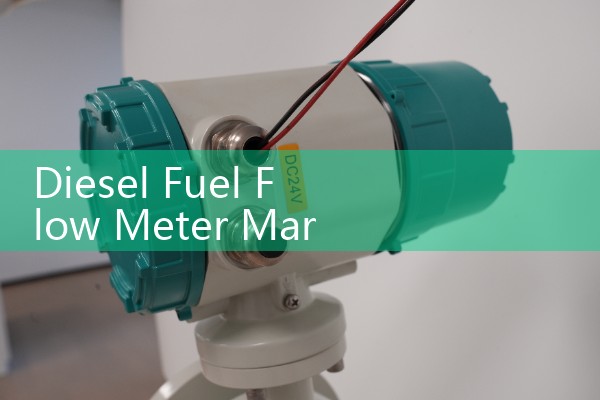
Typical installation on a 500 kW marine diesel engine uses DN15 or DN20 process connections. Flow range runs from 20 L/h up to 1,200 L/h for the small model. Larger engines (up to 2,000 kW) need DN25 or DN40. The oval gear rotor creates a pressure pulse that a Hall‑effect sensor converts into a frequency signal. That pulse output can be wired directly to a digital totalizer or a paperless recorder without an extra 24 V DC supply if the sensor is reed switch type. We recommend the Silver Instruments OGM‑AL‑EX version with 4‑20 mA + HART for areas classified as ATEX Zone 1. The aluminium housing is IP67. The display shows both instantaneous flow rate (L/h) and total consumption (L). Most engineers skip the display and just pipe the signal into the engine monitoring system.
Making Logbook Data Automatic and Audit‑ready
Manual logbooks often contain gaps. A crew member forgets to record hourly consumption. Handwriting is unreadable. When port state control inspects the fuel record book, those gaps become a problem. In practice, automatic flow meters close those gaps. The meter sends a signal every 10 seconds. A simple paperless recorder logs the data with a time stamp. You can export the file in CSV, print it, and staple it into the official logbook. We have seen fisheries authorities in Australia accept this format for vessel fuel efficiency audits. One customer in Vietnam installed six OGM‑AL meters on a 1,200 dwt cargo ship. He linked them to a Silver Instruments 12‑channel paperless recorder. The crew now spends zero minute
For vessels looking to track fuel efficiency in real time, the flow meter output can be scaled in kg/h if you add a PT100 temperature probe and a simple density compensation factor in the PLC. Diesel density varies from 820 to 860 kg/m³ depending on grade and temperature. With a HART signal, the transmitter sends both flow rate and temperature. This lets the control system calculate mass flow. That is useful for fuel performance curves and to detect engine efficiency drift early.
Selecting the Right Silver Instruments Marine Diesel Meter
We build most diesel flow meters on an aluminium oval gear platform. The wetted parts include hard‑anodised aluminium rotors, FKM O‑rings, and stainless steel shafts. For high‑sulphur diesel or occasional gasoline mixed in, we can switch to PTFE seals and 316L rotor options. Process connections are BSPP or NPT threads; flanged connections are available from DN40 upward. Typical accuracy is ±0.5% across a 10:1 turndown. Repeatability is better than ±0.1%, which matters most for trend logging. The meter needs a straight pipe run of only 5 × DN upstream and 3 × DN downstream, so it fits into tight engine room spaces. If you have a return line, install a second meter on the return leg and subtract the flows in the PLC.
Silver Automation Instruments has shipped these meters to marine operators in Nigeria, the Philippines, Chile, Saudi Arabia, and Indonesia. Our team can pre‑configure the pulse scaling factor for your logger or ship automation supplier. Just tell us the engine model, fuel supply pressure (bar), typical fuel temperature (°C), pipe diameter (DN), and the expected flow range (L/h). This saves you time during commissioning.
FAQ
Q: Does an oval gear flow meter create a pressure drop that affects engine fuel supply?
A: The pressure drop is usually less than 0.2 bar at maximum flow for a correctly sized meter. Most marine fuel supply pumps deliver 3 to 5 bar. There is no noticeable effect on engine performance if you do not undersize the meter.
Q: Can I use this meter with biodiesel blends?
A: Yes. Standard FKM seals handle B10 and B20 without swelling. For higher blends or pure biodiesel, let us know when you request a quote. We will change to PTFE seals and check the rotor material.
Q: What output signal works best with a simple engine room data logger?
A: A reed‑switch pulse output is the simplest option. Each pulse equals a fixed volume (e.g. 10 mL/pulse). Your logger counts pulses over time. If you need 4‑20 mA and digital communication, choose the HART version.
Q: How do I prove the meter to a marine surveyor?
A: Silver Instruments provides a factory calibration certificate traceable to national standards. We can also supply a portable positive displacement meter prover if you need on‑board verification. Tell us your port state requirements when ordering.
Q: Where can I see a typical installation diagram?
A: Visit flow‑meter.com.au and search “oval gear diesel flow meter marine”. The product page includes CAD drawings, wiring diagrams, and a PDF manual. You can also send us an email and we reply with the documents within one working day.
To request a quote or technical datasheet for a diesel fuel flow meter for marine logbooks, please send your flow range (L/h), pressure (bar), temperature (°C), pipe size (DN), and required output signal. Reach our marine instrumentation team at [email protected], call +86‑25‑68650347, or message us on WhatsApp (+86‑25‑52155837) or WeChat (+86 13512131526). All units ship from our Nanjing facility with full calibration reports.