

 Current position > News detail
『IFM Air Flow Meter Sizing: Optimizing Compressed Air Consumption with SD Sensors』Related information(v cone flow meter|rotary gas meter|gallon meter|gear meter|metal tube rotameter|glass tube rotameter|nutating disk meter|transit time ultrasonic flow meter|wedge flow meter|pd meters|hydraulic flow meter|ultrasonic water flow meter|water flow meter|air flow meter|magnetic water flow meter|oxygen flow meter|gas flow meter|argon flow meter|air velocity meter|gasoline flow meter|fuel flow meter|ultrasonic water meter|digital water meter|nitrogen flow meter|solid flow meter|Oxygen tank flow meter|digital water flow meter|diesel fuel flow meter|steam flow meter|02 flow meter|compressed air flow meter|oil flow meter|liquid flow meter)

Air Flow Meter Sizing: Optimizing Compressed Air Consumption with SD Sensors
Quick Answer: Thermal mass flow meters using insertion probes similar to SD sensor technology measure mass flow directly. No pressure or temperature compensation is needed in the pipe. Correct meter sizing, insertion depth, and range setting will uncover compressed air leaks and trim your electricity bill fast.
Why Correct Air Flow Meter Sizing Saves Real Money
Many plants in Thailand and the Philippines run screw compressors 24 hours a day without measuring air flow to each drop line. A single 3 mm leak at 7 bar can waste more than 2,100 USD in electricity per year. That is not a guess. We have pulled data from customer audits in Ho Chi Minh City and Surabaya.
Engineers often pick a flow meter by pipe diameter alone. This causes a big problem. A thermal mass flow meter sized for a DN150 pipe will not read well if actual flow stays at 10% of full scale most of the time. The SD sensing principle relies on a heated probe and a temperature sensor measuring the cooling effect of flowing gas. At low velocities the signal gets noisy. At very high velocities the probe can flutter or saturate.
Proper sizing means you pick the probe length, the measurement range (for example 0 to 150 Nm3/h or 0 to 500 Nm3/h), and the process connection type, all matched to your actual consumption pattern. This is where a simple call with real numbers beats any online configurator.
How the SD Insertion Probe Simplifies Compressed Air Monitoring
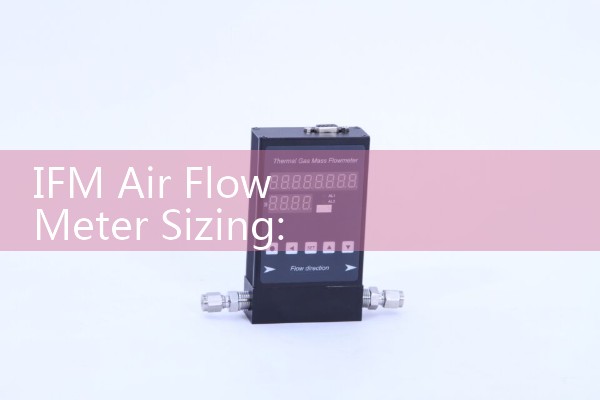
The IFM SD sensor family is a common sight in European and Southeast Asian automotive lines. It is an insertion thermal mass flow meter with a built-in display. The probe inserts through a 1/2 inch ball valve, keeping installation easy and hot tapping possible. A factory can install one without shutting down the main air header. Silver Automation Instruments supplies insertion thermal mass flow meters that follow the same mechanical standard. Our probes fit R 1/2 and NPT 1/2 process connections. You can pull out the old probe, slide in ours, and start logging.
In the sensor itself a reference RTD and a heated PT100 sit side by side. Gas flows over the heated element and carries away heat. The electronics translate this mass velocity into Nm3/h or kg/h directly. Because the measurement is mass-based, a plant in Mexico at 2,200 m altitude gets the same reading as a plant in Singapore at sea level. No extra correction factors. No external pressure transmitter needed for the flow computer.
One thing we tell field engineers is to check the sensor tip orientation. The tip must point toward the flow centerline and the arrow on the probe body must align with flow direction. A 15-degree offset can cause a 5% to 10% under-reading. We saw this last month on a new installation in a Dubai food packaging line. After a quick video call, the local electrician rotated the probe and the readings snapped into expected values.
Selecting the Right Range and Insertion Depth
Selection starts with three numbers from your site. Pipe inner diameter (DN), minimum flow in normal cubic meters per hour, and maximum flow. A typical compressed air application in a textile mill: DN80 pipe, minimum 20 Nm3/h at lunch break, maximum 180 Nm3/h when all looms run. Our model TMF80x-150 would fit that profile well. It has a turndown ratio of 1:100 and a standard output of 4-20 mA plus pulse.
For a larger DN200 ring main in a Saudi Arabian dairy, the minimum night flow was 80 Nm3/h and peak day flow 900 Nm3/h. We proposed a longer probe stem with a flow range of 0 to 1200 Nm3/h. The customer used the 4-20 mA signal to feed their Siemens PLC and trigger an alarm when flow in no-production hours stayed above a threshold. That alarm spotted a stuck open drain valve on a dryer line within three nights.
Insertion depth matters a lot. An insertion probe should reach the center of the pipe for fully developed turbulent flow. Too short and it reads a low boundary layer velocity. A wrong depth can cause a 20% to 30% error. Our flow meters ship with a depth marking tool and a compression fitting that sets the correct position on DN15 to DN300 pipes.
Field Details That Prevent Installation Headaches
Compressed air is never perfectly clean. Even after refrigerated dryers, a small amount of oil vapor and water mist travels with the air. The SD style probe with a coated sensor tip handles light oil carryover decently. In a palm oil refinery in Malaysia we recommended a protective sintered shield around the sensor elements. This shield did not affect response time noticeably but kept sticky residue off the RTDs. The plant now cleans it once every six months instead of every three weeks. This small change kept the cost of ownership low.
Another point: the flow conditioner. If you have poor straight run, say just 5D upstream of an elbow, the velocity profile tilts. Thermal probes see this tilt and give a biased reading. Silver Instruments offers a flow conditioning plate that fits between flanges. We often suggest it for compact skid installations where welding a longer spool piece is not practical. This plate is not integrated into the meter, but the combined price still falls below most inline Coriolis meters for air service.
FAQ
Can this thermal flow meter directly replace an IFM SD sensor?
In almost all cases yes. The probe diameters and thread types match standard 1/2 inch ball valve ports. We can provide the same electrical connector pinout. Send us a photo of the old sensor label and we will confirm.
What is a typical delivery time for Southeast Asia and the Middle East?
We keep insertion probes for DN50, DN80, and DN100 in Nanjing stock. Standard delivery is 5 to 7 working days by DHL. Custom range scales add 3 days. We have shipped to Dammam, Surabaya, and Monterrey without customs delays.
Does the meter work with oil-lubricated screw compressors?
Yes. The sensor tip is resistant to light oil mist. For heavy carryover we suggest a sintered filter cap. The measuring head can be cleaned easily by unscrewing the probe and wiping with isopropyl alcohol.
What outputs do you provide?
Standard is 4-20 mA HART and a pulse output for totalization. Modbus RTU is an option. The digital display shows Nm3/h, deg C, and total m3.
How do I get a firm quotation for my compressed air line?
Send us your pressure (bar), temperature (deg C), pipe size (DN), and flow range (min and max Nm3/h or kg/h). Include a photo of the pipe where the meter will go. You will get a datasheet, price in USD, and shipping cost within one working day.
Contact Silver Automation Instruments
Email: [email protected]
Tel: +86-135-1213-1526
Whatsapp: 86-135-12131526
WeChat: +86 13512131526
Website: flow-meter.com.au